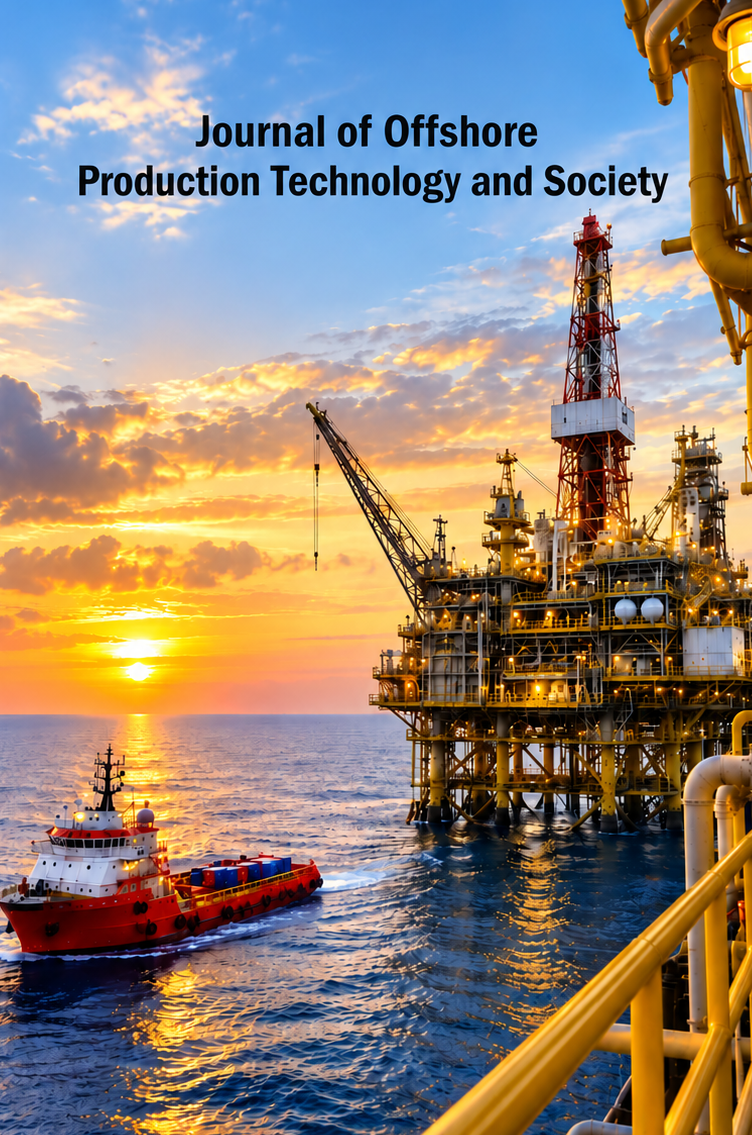
The Development of Offshore Production Technology and Its Impact on Coastal Communities
Keywords:
Offshore Technology, Oil and Gas Production, Coastal Communities, Marine Environment, SustainabilityAbstract
The development of offshore production technology is an important part of improving the ability of the oil and gas industry to utilize energy resources in the marine area. Technological advances such as offshore platforms, subsea systems, automation, remote monitoring, and other supporting technologies have increased efficiency, productivity, and safety in production activities. However, these developments have also caused various changes to the environment and the lives of people in coastal areas. Coastal communities that are dependent on marine resources can experience changes in economic and social activities as a result of increasing offshore production activities. The influence of offshore production technology on coastal communities can be positive or negative. On the one hand, industrial activities can open up job opportunities, increase economic activities, provide infrastructure development, and encourage the development of community skills. On the other hand, production activities can potentially cause disturbances to fishermen's activities, changes in marine environmental conditions, and competition in the use of coastal space and resources. Therefore, the development of offshore production technology needs to be accompanied by environmental management and attention to the socio-economic conditions of the community. The application of more efficient, safe, and sustainable technology is one of the efforts to reduce negative impacts while increasing the benefits of offshore production activities. Community involvement in coastal area management, improved communication between industry and the community, and the implementation of environmental safety and protection standards are needed to create a balanced relationship between industrial activities and the lives of coastal communities. Thus, the development of offshore production technology is not only directed at increasing production, but also needs to consider environmental sustainability and the welfare of coastal communities.
References
[1] Z. Cheng et al., “Optimization of Offshore Production in Real-Time Intelligent Completion Operation with Use of Reservoir-Wellbore Dynamic Coupling Analysis Methods,” Middle East Oil, Gas Geosci. Show (MEOS GEO), 2025, doi: 10.2118/227285-ms.
[2] J. Glasson, B. Durning, K. Welch, and T. Olorundami, “The local socio-economic impacts of offshore wind farms,” Environ. Impact Assess. Rev., 2022, doi: 10.1016/j.eiar.2022.106783.
[3] O. Joshua, Ochulor, O. J. Ochulor, O. Sofoluwe, A. Ukato, and D. D. Jambol, “Technological advancements in drilling: A comparative analysis of onshore and offshore applications,” World J. Adv. Res. Rev., 2024, doi: 10.30574/wjarr.2024.22.2.1333.
[4] V. L. Owusu, E. T. Lawer, M. Adjei, and M. Ogbe, “Impact of offshore petroleum extraction and ‘ocean grabbing’ on small-scale fisheries and coastal livelihoods in Ghana,” Marit. Stud., vol. 22, pp. 1–14, 2023, doi: 10.1007/s40152-023-00307-3.
[5] E. Methratta, A. Hawkins, B. Hooker, A. Lipsky, and J. Hare, “Offshore Wind Development in the Northeast US Shelf Large Marine Ecosystem: Ecological, Human, and Fishery Management Dimensions,” Oceanography, 2020, doi: 10.5670/oceanog.2020.402.
[6] N. Trifonova, B. Scott, S. Watson, C. Szostek, M. Declerck, and N. Beaumont, “Fishing, offshore wind energy, climate change and marine spatial planning: Is it possible to plan for a best use of space?,” School. Solut. Evid., 2025, doi:10.1002/2688-8319.70039.
[7] O. Ojuekaiye, “Industry 4.0 Remotely Operated Vehicle Management for Safer, Greener Oil and Gas Operations,” OALib, 2025, doi: 10.4236/oalib.1113398.
[8] A. Guthrie et al., “Assessing socio‐environmental suitability and social license of proposed offshore aquaculture development: A Florida case study,” J. World Aquac. Soc., 2023, doi: 10.1111/jwas.13031.
[9] C. Amaechi, A. Reda, H. O. Butler, I. Ja’e, and C. An, “Review on Fixed and Floating Offshore Structures. Part I: Types of Platforms with Some Applications,” J. Mar. Sci. Eng., 2022, doi: 10.3390/jmse10081074.
[10] N. Andrews et al., “Oil, fisheries and coastal communities: A review of impacts on the environment, livelihoods, space and governance,” Energy Res. Soc. Sci., vol. 75, p. 102009, 2021, doi: 10.1016/j.erss.2021.102009.
[11] S.-L. Billing et al., “Combining wind power and farmed fish: Coastal community perceptions of multi-use offshore renewable energy installations in Europe,” Energy Res. Soc. Sci., 2022, doi: 10.1016/j.erss.2021.102421.
[12] C. Novaglio et al., “Deep aspirations: towards a sustainable offshore Blue Economy,” Rev. Fish Biol. Fish., vol. 32, pp. 209–230, 2020, doi: 10.1007/s11160-020-09628-6.