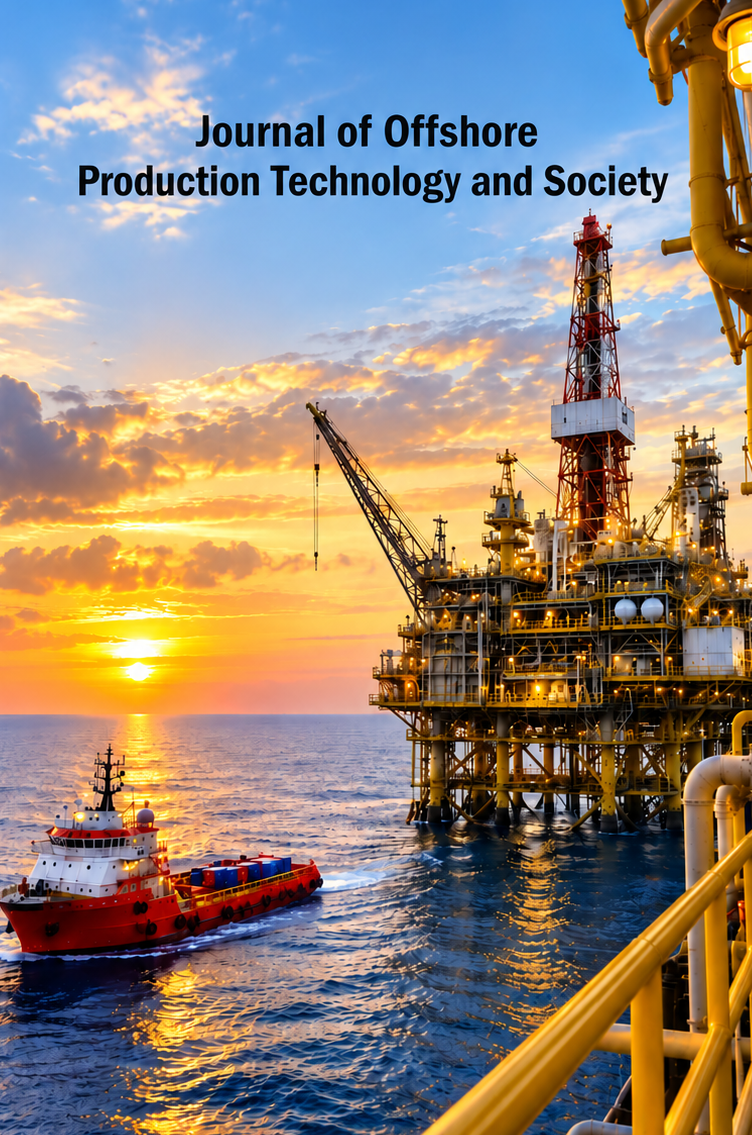
Transforming Offshore Production Technology Toward Environmentally Sustainable Operations
Keywords:
Offshore Production, Sustainable Technology, Environmental Sustainability, Digitalization, Emission ReductionAbstract
The offshore oil and gas industry has an important role to play in meeting energy needs, but it also faces various challenges related to environmental impacts, greenhouse gas emissions, energy consumption, and the protection of marine ecosystems. The transformation of offshore production technology towards sustainable operations is important to create a balance between energy production needs and environmental responsibility. This article discusses the transformation of offshore production technology through the application of digitalization, energy-saving systems, renewable energy integration, emission reduction technology, and improved waste management. The use of advanced monitoring systems, artificial intelligence, Internet of Things (IoT), and automation can improve operational efficiency while reducing energy consumption and environmental risks. In addition, the integration of renewable energy sources and carbon management technologies can be an alternative in reducing the carbon footprint of offshore facilities. However, the sustainable implementation of offshore operations requires significant investment, technological readiness, competent human resources, and effective environmental regulatory support. The integration of technological innovation with good environmental management is expected to create offshore production operations that are more efficient, safe, resilient, and environmentally responsible. The transformation can also support the sustainability of the energy industry while preserving the marine ecosystem.
References
[1] S. Mohammadi, C. F. Berg, and H. Schümann, “Low-emission offshore oil and gas production: A review of achievements and challenges,” J. Clean. Prod., 2025, doi: 10.1016/j.jclepro.2025.146504.
[2] N. Hamzah, T. Mutallimov, C.-T. Panaitescu, M. Grant, G. Cristofoli, and H. Tan, “A modular digital twin architecture for offshore safety and decision-making: A North Sea platform case study,” Reliab. Eng. Syst. Saf., vol. 274, p. 112428, 2026, doi: 10.1016/j.ress.2026.112428.
[3] W. Gallo, “Diagnosis of GHG Emissions in an Offshore Oil and Gas Production Facility,” Gases, 2024, doi: 10.3390/gases4040020.
[4] Y. Hrybinyk and D. Yahidka, “ADVANCES IN SUSTAINABLE PRACTICES AND STRATEGIES FOR MITIGATING THE ENVIRONMENTAL IMPACT DURING OFFSHORE OIL AND GAS PRODUCTION,” Int. Sci. Unity, 2026, doi:10.70286/isu-12.08.2026.008.
[5] B. Karimov, A. Deshpande, and M. Torres, “Digital Twin Integration for Lifecycle Management of Operating Industrial Facilities Under Continuous Production Conditions,” Am. Impact Rev., 2026, doi: 10.66308/air.e2026016.
[6] K. C. Vong et al., “Strategic Human Resource Development for Industry 4.0 Readiness: A Sustainable Transformation Framework for Emerging Economies,” Sustainability, 2025, doi: 10.3390/su17156988.
[7] M. Kabeyi and O. Olanrewaju, “Sustainable Energy Transition for Renewable and Low Carbon Grid Electricity Generation and Supply,” vol. 9, 2022, doi: 10.3389/fenrg.2021.743114.
[8] X. Hu, J.-W. Chen, H. Zhou, and Z. Ren, “Development of underwater electric manipulator based on interventional autonomous underwater vehicle (AUV),” J. Zhejiang Univ. A, vol. 25, pp. 238–250, 2024, doi: 10.1631/jzus.a2200621.